
A new outlook on polygons.

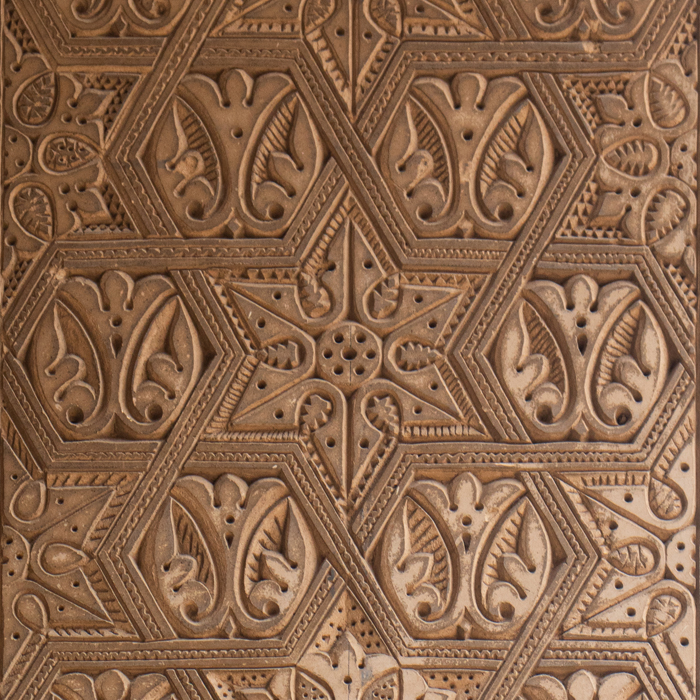
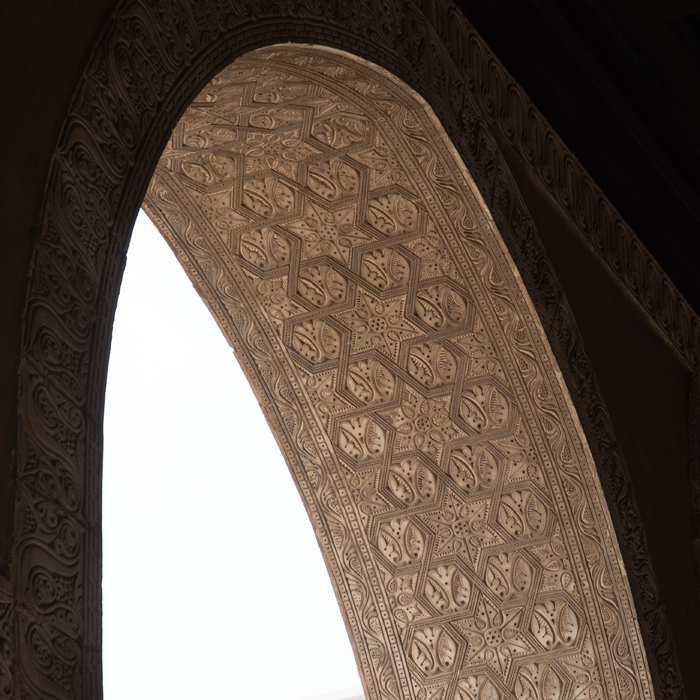
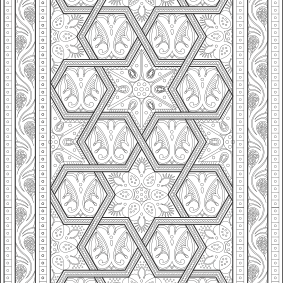
The patterns of Ibn Tulun Mosque are among the earliest Islamic designs to exhibit three-fold and six-fold symmetry. In this displayed pattern from the mosque’s soffits, a number of elements further reflect a transformation in the visual literacy of craftspeople during the ninth century, which led to the proliferation of similar designs in later periods.

Even though this pattern was inspired by the Abbasid Samarra style in stucco decoration, the use of geometry in the Abbasid artistic tradition was a little different from what we see here in the Tulunid period. In Samarra stucco, circular and square grids were used as frames for the abstracted palmettes and vegetal motifs. In this pattern, however, the geometric grid itself becomes an independent part of the design rather than a mere frame attached to the vegetal elements. 

The new understanding of polygons as patterns instead of mere design guides resulted in the intensification of Islamic strapwork—the geometric interlace began to acquire a life of its own. Looking closely at the displayed pattern, one can see how the hexagonal strapwork seems to come forward while the filler vegetal motifs recede. This creates a subtle competition between the vegetal and geometric ornament for the overall visual appearance. With each glance, the vegetal and geometric elements take turns, one appearing to dominate the other .

By treating polygons as patterns, artists of Tulunid Cairo were able to create visual layers within the same design without having to use completely novel forms. Due to this intellectual shift in design, geometric ornament paired with floral and vegetal motifs became heavily utilised in later periods, which eventually led to the crystallisation of the arabesque. In fact, this particular pattern on display became quite popular in different regions of the world from Spain to India, and appears on various media from wooden doors to stone screens.

It is important to acknowledge that modern analyses of the stucco decorations of Ibn Tulun Mosque (including ours) are based on incomplete information. This is because the mosque has experienced several episodes of disrepair which led to the permanent loss of many parts of its original ornament. For instance, studies suggest that this pattern was originally painted with multiple colours, which would have certainly affected the appearance of the design. The mosque was also heavily restored multiple times throughout history, which means that even original ninth-century sections of the building have been retouched by several generations of artisans.


Variations:

Local:

Qalawun Complex, Cairo. Stucco window grilles. (Mamluk)

Museum of Islamic Art, Cairo. Abbasid stucco panels. [Inv. Nos. 13849, 13865] 

Museum of Islamic Art, Cairo. Tulunid carved wooden panel. [Inv. No. 13173]  

Ibn Tulun Mosque, Cairo. Stucco soffits. [Patterns 038, 039]


Regional:

Ala’i Darwaza, India. Jali screen. (Khalji)

Ala’i Darwaza, India. Stone carving. (Khalji)

Aljaferia Palace, Spain. Carved wooden doors. (Taifa period)

Shah-i-Zinda Complex, Samarkand. Tilework. (Timurid)

Khan al-Wazir, Aleppo. Stone carving. (Ottoman)

Pattern ID Card
Description

This pattern is framed by a double pearl band on either side with a wave-like vegetal band running between the pearls. Known as Samarra Style B, the main band of the pattern is made of abstract vegetal motifs within a geometric border of intersecting hexagons. Every six hexagons form a six-pointed star. The filler ornament of the hexagons are abstracted palmettes and half-palmettes with winged leaves that are influenced by the Sasanian wing motif. Central six-pointed stars are decorated with a less abstract style of leaves, while corner half-stars are decorated with fleur-de-lis petals.

Building

Ibn Tulun Mosque

Monument Number

220

Period

Tulunid

Provenance

In situ

Date

AH 263–265 | 876–879 CE

Typology

Geometric-Vegetal 

Motifs

Fleur-de-lis, Half-palmette, Winged-leaf

Craftsperson

Unknown

Colors

Monochrome

Natural/Beige

Materials

Stucco

Techniques

Carving

Composition

Layered Pattern

Grid

Hexagonal

Shapes

Hexagon, Six-pointed star, Square

Location

Al-Sayyida Zaynab District, Ahmad ibn Tulun Sq.

One of the soffits of the arcade around the courtyard.

Patron

Ahmad ibn Tulun, founder of the Tulunid Dynasty and ruler of Egypt from 868 to 905.

References

Bibliography

Azab, Pamela Mahmoud. 2015. “The Sources of Ibn Tulun's Soffit Decoration.” M.A. Thesis. American University in Cairo. https://fount.aucegypt.edu/etds/621.


Bloom, Jonathan. 1993. “On the Transmission of Designs in Early Islamic Architecture.” Muqarnas 10: 21–28.


Bonner, Jay. 2017. Islamic Geometric Patterns: Their Historical Development and Traditional Methods of Construction. Springer.


“Bourgoin, Plate 1, top,” Patterns in Egypt. Tiling Search [October 29, 2024]. https://tilingsearch.mit.edu/HTML/data147/F254J.html.


Creswell, K.A.C. 1979. Early Muslim Architecture, Vol II. Hacker Art Books. 


El-Akkad, Tarek. 2013. “The Aesthetics of Islamic Architecture & the Exuberance of Mamluk Design.” PhD Diss. University of Catalonia. CORE, The Open University. https://core.ac.uk/download/19933730.pdf.


Field, Robert. 2000. Geometric Patterns from Islamic Art & Architecture. Tarquin Publications.


Golombek, Lisa. 1969. “Abbasid Mosque at Balkh.” Oriental Art 15: 173–189.


Herzfeld, Ernst. 1910. “Die Genesis der islamischen Kunst und das Mshatta-Problem.” Der Islam 1, no. 2: 105–144. https://doi.org/10.1515/islm.1910.1.2.105.


O’Kane, Bernard. 2016. The Mosques of Egypt. American University in Cairo Press.


O’Kane, Bernard, Mohamed Abbas, and Imam R. Abdulfattah. 2012. The Illustrated Guide to the Museum of Islamic Art in Cairo. American University in Cairo Press.

Images

Drawings: Esraa Kamal and Hussein Jamal

Postproduction: Farida Saraya, Salma Samir, Menna Abdallah Ahmed, Radwa Abdullah, and Nada Elsayed

Photography: “Detail” and “context” photos by Nada Hany Shendy;

“pattern” photo by Francisca Reis

All Contributors
Author

Research and text: Yumna Moussa

Arabic translation: Nihal Shallal

English copy editing: Nour Bahgat

Arabic copy editing: Reham Zein ELabdeen and Heba Negm