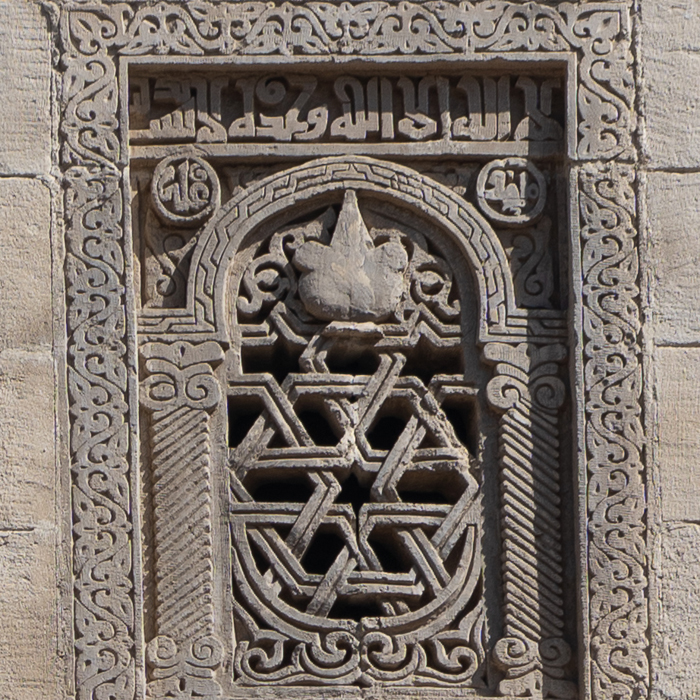
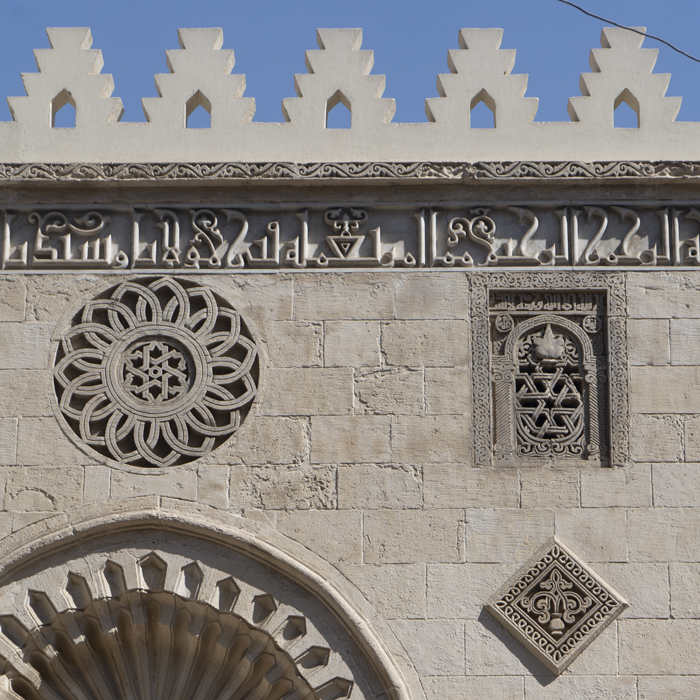
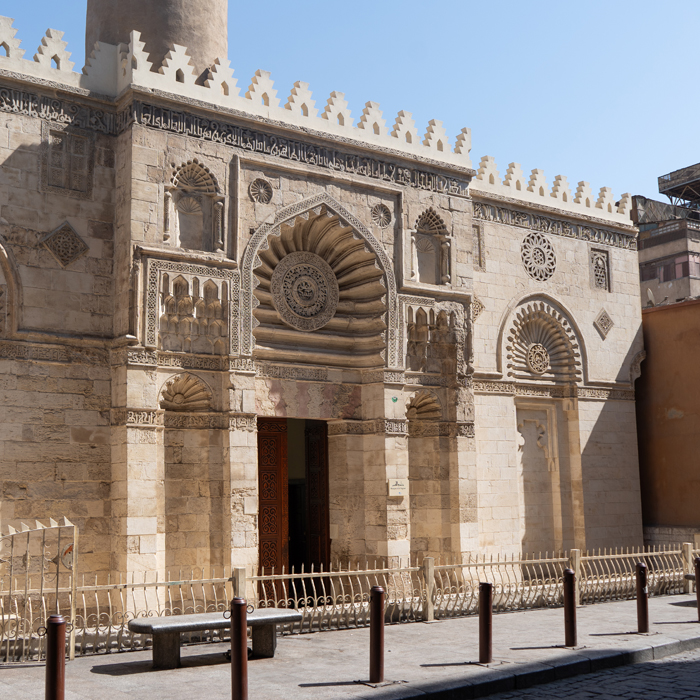
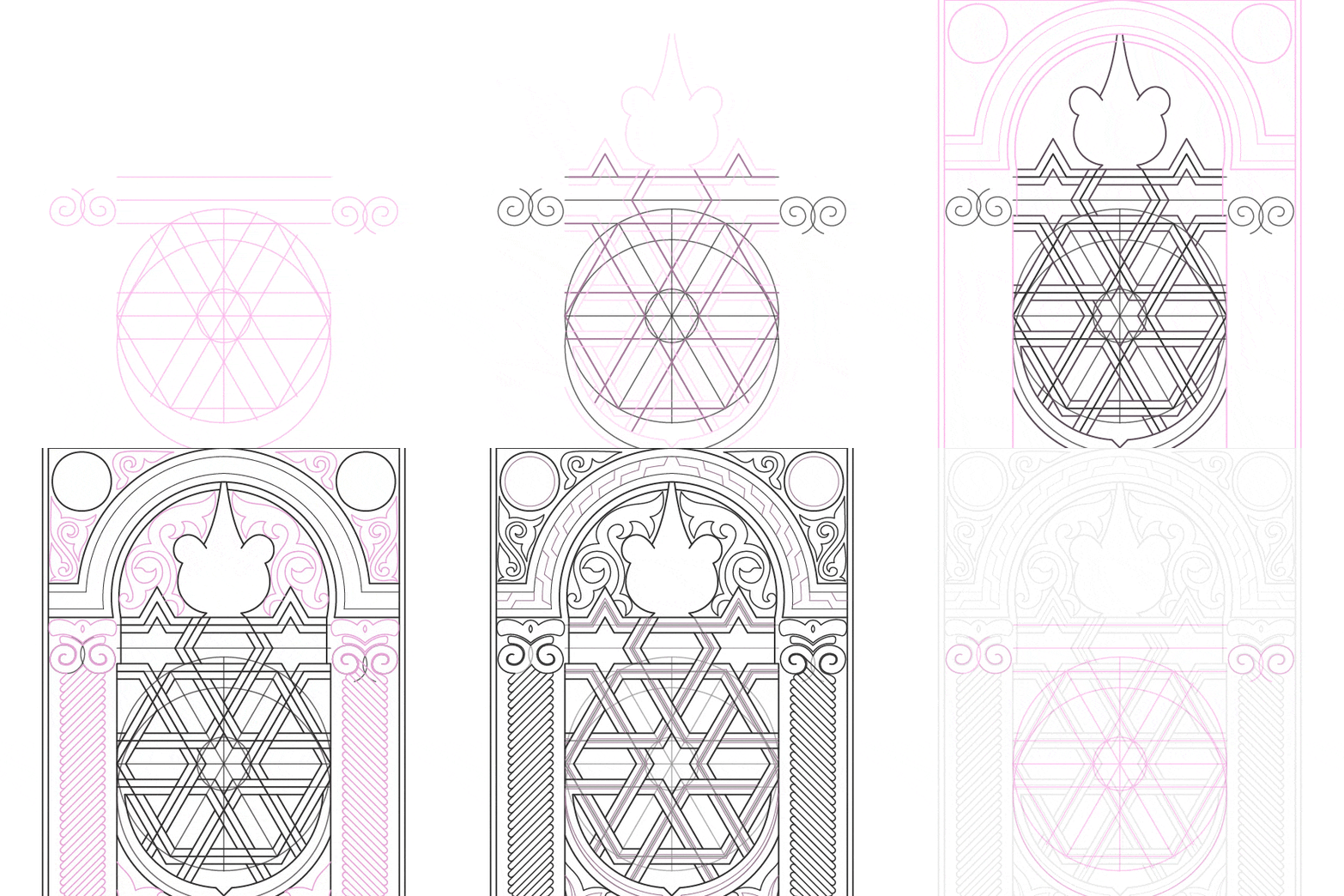

This stone pattern consists of a niche-like composition (an arch flanked by two columns) with a frame of vegetal carvings. On either side of the niche lies an ornamental roundel, above which is an inscription of the shahada. Within the niche hangs a lamp above a star-shaped grille. Such a combination of lamp and grille within a niche has various symbolic interpretations within Islamic art.
al-Aqmar Mosque
33
Fatimid
In situ
AH 519 | 1125 CE
Geometric, Abstract, Vegetal
Split-palmette, Kidney-shaped leaf
Unknown
Natural
Stone
Carved
Layered pattern
Hexagonal
Hexagon, Six-pointed star
al-Mu‘izz Street.
Façade, upper far-left side.
Ma’mun al-Bata’ihi, vizier of the Fatimid caliph al-’Amir bi Ahkam Allah.
References
Bibliography
Behrens-Abouseif, Doris. 1989. Islamic Architecture in Cairo: An Introduction. American University in Cairo Press.
———. 1922. “The Façade of the Aqmar Mosque in the Context of Fatimid Ceremonial.” Muqarnas 9: 29–38.
Creswell, K.A.C. 1979. The Muslim Architecture of Egypt. Vol. 1. Hacker Art Books.
Graves, Margaret S. 2018. “The Lamp of Paradox.” Word & Image 34 (3): 237–250.
Mulder, Stephennie. 2014. “Seeing the Light: Enacting the Divine at Three Medieval Syrian Shrines.” In Envisioning Islamic Art and Architecture, pp. 88–108. Brill.
O’Kane, Bernard. 2016. The Mosques of Egypt. American University in Cairo Press.
Sanders, Paula. 2008. Creating Medieval Cairo: Empire, Religion, and Architectural Preservation in Nineteenth-Century Egypt. American University in Cairo Press.
Williams, Caroline. 1983. “The Cult of ‘Alid Saints in the Fatimid Monuments of Cairo, Part I: The Mosque of al-Aqmar.” Muqarnas 1: 37–52.
Images
Drawings: Hossam Elganainy
Postproduction: Nada Elsayed
Photographs: Francisca Reis
Author
Research and text: Yumna Moussa
Arabic translation: Huda Zikry
English copy editing: Nour Bahgat
Arabic copy editing: Reham Zein ELabdeen and Heba Negm