
How scalable and repeatable can a pattern be?

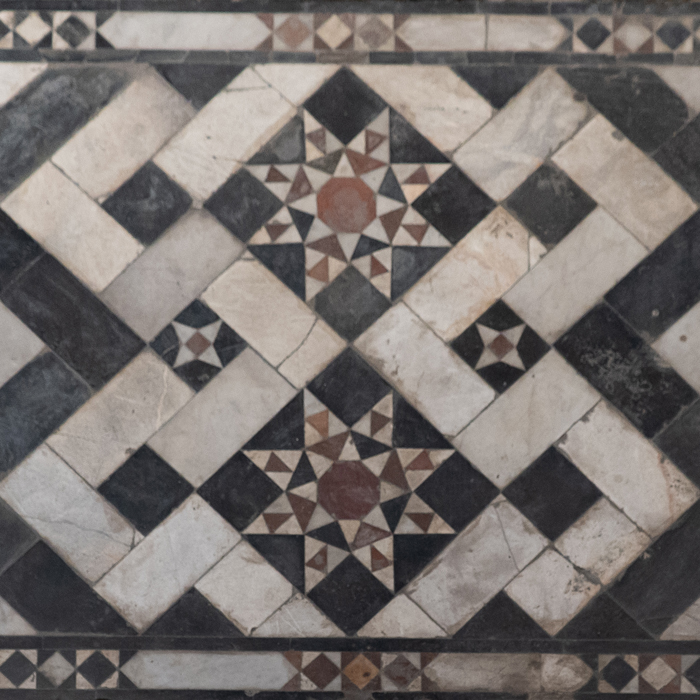
This pattern appears in various historic buildings in Cairo and on different scales: from large iterations on floors and domes, to miniscule wall decorations. Its simple composition—overlapping rotated squares playing with a set of actions—makes it highly scalable. In the picture, the inlaid marble mainly alternates between black and grey, a popular colour scheme, but other variations adopt an alternating red and beige composition.

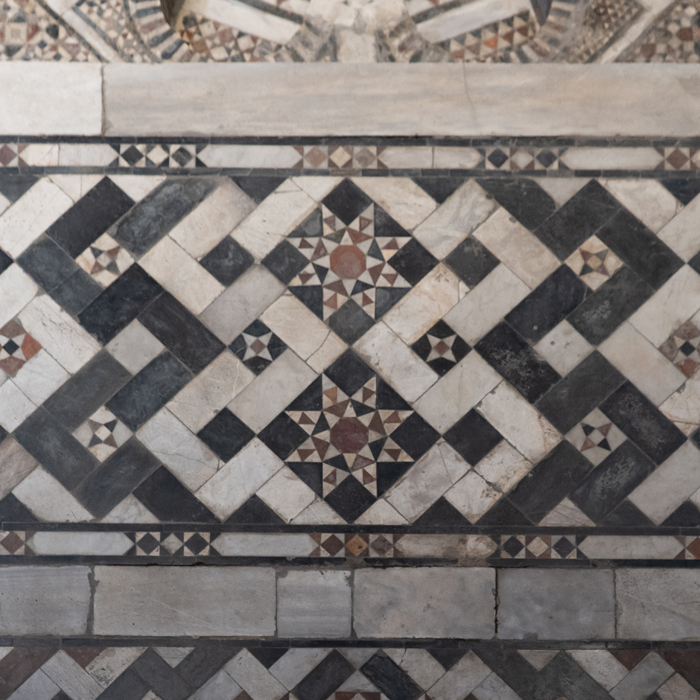
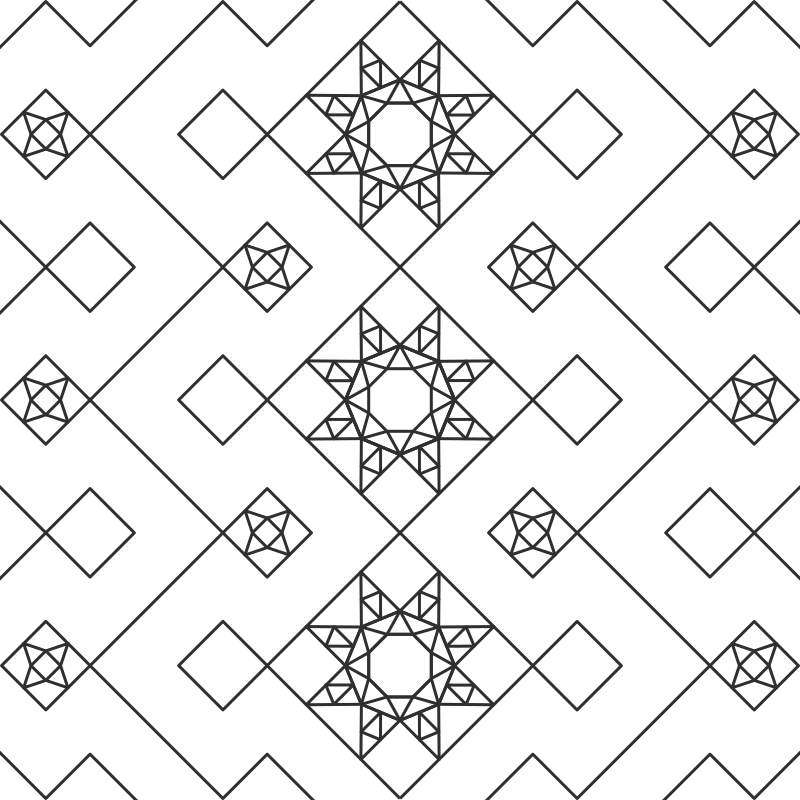
The craftsperson responsible for this iteration added an eight-pointed star in the central rotated square to both emphasise the directionality of the pattern and to add a creative element. The pattern can be viewed as a single linear frieze that is repeated to cover a greater expanse. It is typically found as a single or double strip framing architectural elements like mihrabs or fountains, as is the case with the iteration presented here.

Unfortunately, the pattern’s versatility in scale is offset by limitations on the use of marble. This seems to be the material of preference for the execution of the pattern, despite its high cost. However, a few variations are executed in cheaper materials such as the painted intrados of Khayrbak’s mausoleum dome and the carved extrados of Qurqumas’s mausoleum dome at his khanqah. These two examples are the only instances where, due to the spherical nature of the surface, the pattern appears to repeat almost infinitely. Nevertheless, the painted variations do not live up to the magnificence of the marble.

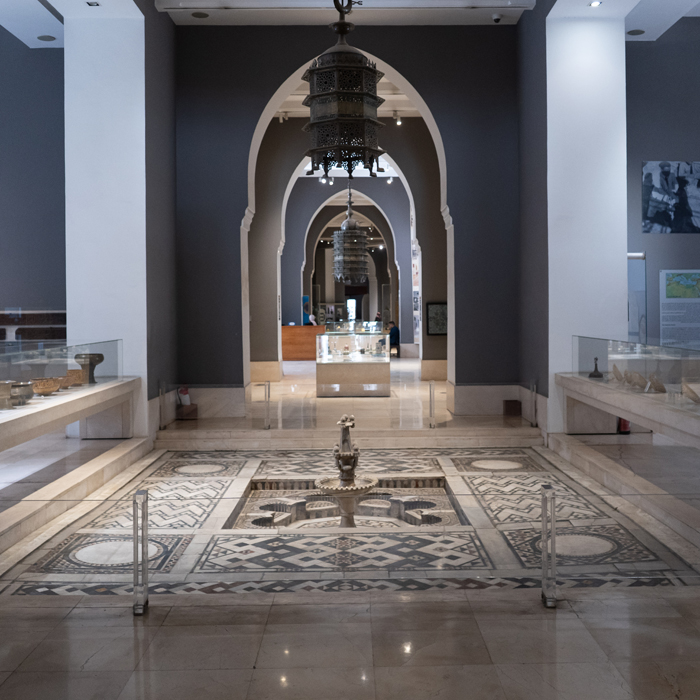
The iteration of the design pictured in this entry originates from a fasqiyya in a traditional Cairene qa‘a, decorated with some relatively large marble panels. This was characteristic of Ottoman marble inlay, mainly reserved for the floor of the durqa‘a in domestic settings (central space in the reception hall). On the other hand, Mamluk marble inlay used smaller-sized tiles, thus allowing for more intricate designs on walls and in mihrabs. In both periods, the pattern is often framed and used as a panel within a larger composition. Here, the frame consists of a double line embedded with a simple arrangement of rotated squares. The same fasqiyya also contains another iteration of the pattern consisting of a single strip with a plain frame.

Like other patterns within the city, the material of this design can sometimes contribute to its invisibility. Many marble decorations within monuments are covered by carpets and other protective material due to the perceived preciousness of marble, while stone variations are often too high for the eye level of the average pedestrian. Thus, to truly experience the exquisite scalability of this pattern, a city dweller must learn to look up or down every once in a while.


Variations :

Local:

Qaytbay Mosque, Cairo. Marble floor. (Mamluk) 


Al-Ashraf Barsbay Mausoleum, Cairo. Marble dado. (Mamluk) 


Al-Maridani Mosque, Cairo. Marble decorations next to the mihrab wall. (Mamluk) 


Zaynab Khatoun House, Cairo. Marble on the walls of qa‘a. (Mamluk)


Sultan al-Mu’ayyad Sheikh Mosque, Cairo. Marble mihrab. (Mamluk) 


Al-Nasir Mohamed Mosque at the Citadel, Cairo. Marble mihrab. (Mamluk) 


Qurqumas Dome, Cairo. Carved stone dome. (Mamluk) 


Al-Burdayni Mosque, Cairo. Marble dado. (Ottoman) 


Khayrbak Complex, Cairo. Painted interior dome ceiling. (Ottoman) 


Mustafa Ja‘far House in Gammaliyya, Cairo. Qa‘a marble fountain. (Ottoman)


Regional:

Shir Dar Madrasa, Samarkand. Banna’i tiles on the façade. (Shaybanid) 


Friday Mosque, Qazvin. Bannai’i tiles. (Seljuk/Safavid)

Pattern ID Card
Description

This pattern features a frieze extending from a central point with a decorative eight-pointed star. The design of the frieze is based on overlapping rotated squares playing with a set of actions that include intersection, exclusion, and division. The frieze is repeated into a two-strip arrangement framed with a border that incorporates simple rotated squares.

Period

Ottoman

Provenance

Originally from al-Hilaliya family’s private Cairene house, the pattern forms part of a fountain which was gifted in 1901 to the Museum of Islamic Art. 

Date

12th century AH | 18th century CE

Typology

Geometric

Motifs

None

Craftsperson

Unknown

Colors

Polychrome
Black, Grey, Red

Materials

Marble

Techniques

Marble

Composition

Single pattern

Grid

Orthogonal

Shapes

Square, Eight-pointed star, Four-pointed star

Dimensions

Approx. 2.15 × 1.0 metres

Location

Museum of Islamic Art, Cairo. [Inv. no. 3078]

Patron

Al-Hilaliya family

References

Bibliography

O’Kane, Bernard, Mohamed Abbas, and Imam R. Abdulfattah. 2012. The Illustrated Guide to the Museum of Islamic Art in Cairo. American University in Cairo Press.


“Shir Dar madrasah.” Patterns in Central Asia, Tiling Search.  https://tilingsearch.mit.edu/HTML/data192/TRA0518.html

Images

Drawings: Nada Hany Shendy

Postproduction: Mariam Ashraf, Salma Samir, Radwa Abdullah, and Nada Elsayed
Photography: Nada Hany Shendy

All Contributors
Author

Research and text: Yumna Moussa
Arabic translation: Huda Zikry

English copy editing: Nihal Nour

Arabic copy editing: Reham Zein ELabdeen