
From hospital iwans to home fountains. 

Several iterations of this pattern appear in the buildings of Almohad Caliph Muhammad al-Nasir (r. AH 595–611 | 1199–1213 CE), pointings towards a western Islamic influence on Cairene patterns. Al-Nasir was an avid patron of the arts, known for his mosque restorations in Fez during the early thirteenth century. Likely, one of the craftspeople he employed was responsible for the migration of this pattern to Cairo.

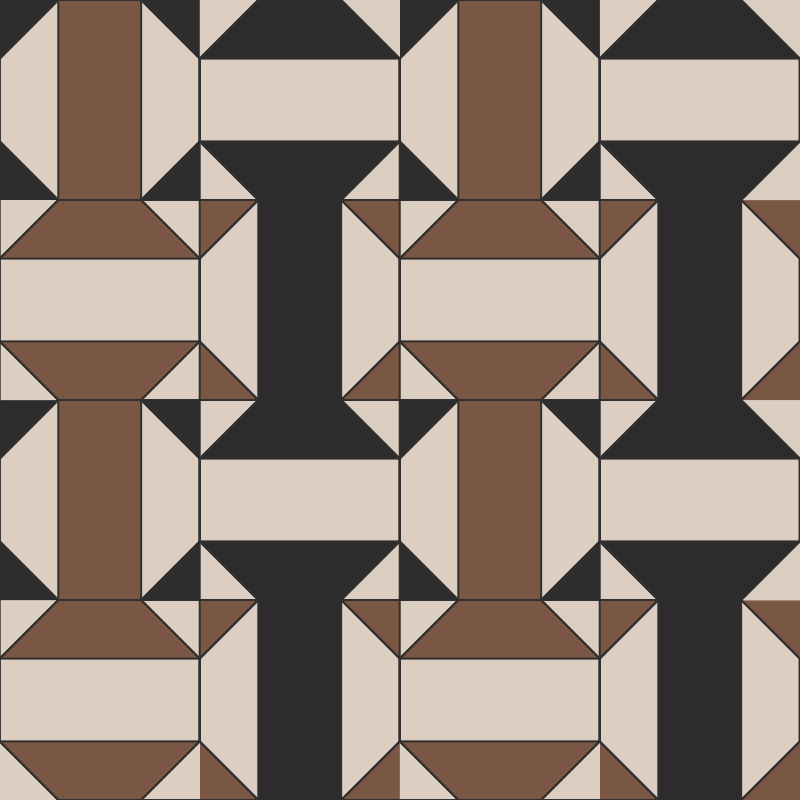
The displayed design is known in the Moroccan dialect as shughul ban, or “the work has unfolded.” According to local zillij tile masters, shughul ban is one of the earliest forms of tastir, or geometric patterns, to be composed from classical square mosaic tiles.

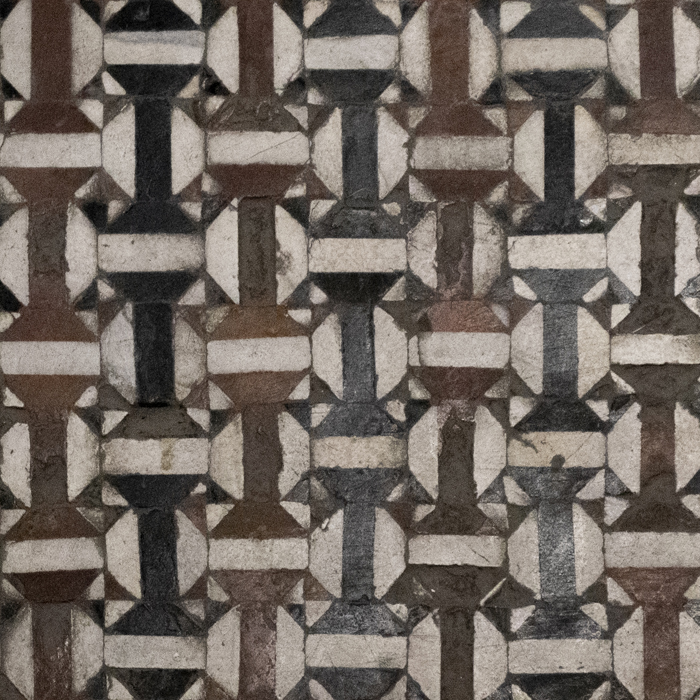
Less than a century later, we find the same pattern in Cairo at the Qalawun Complex on the walls of its hospital’s iwans. The corner pieces of each square are much smaller and more intricate than the variations found in Morocco; they appear to form alternating arrow-like shapes across the matrix. This pattern is stunningly ordered not just because it lacks a singular focal point, but because it actively disorients the viewer’s eye by directing it both laterally and longitudinally. 

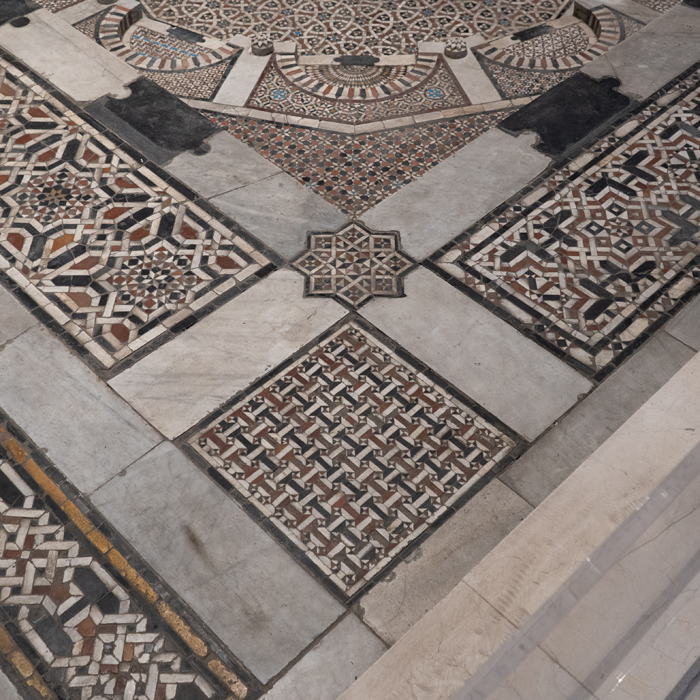
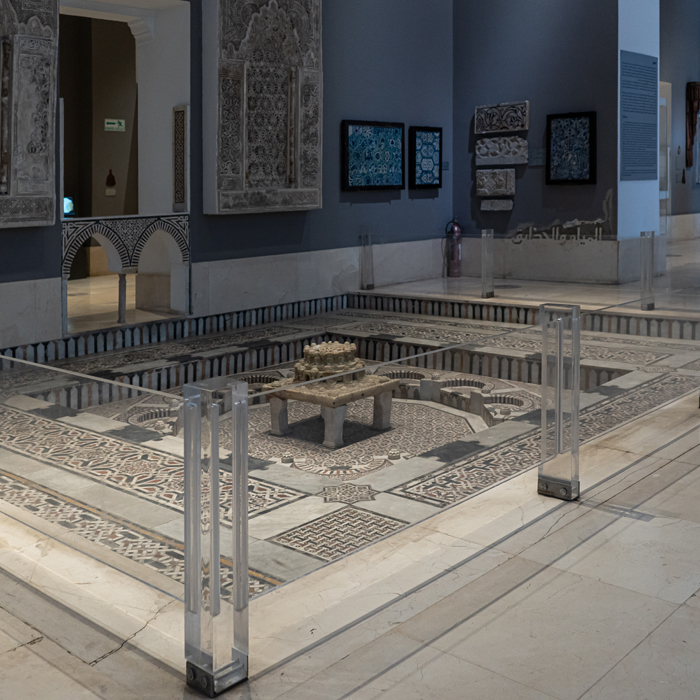
As a later example, the shown instance of this pattern dates to the eighteenth century. This particular pattern is one of four patterns in this database (Patterns 013, 025, and 026) that come from the same fasqiyya (fountain)  displayed in the Museum of Islamic Art in Cairo. The fasqiyya was moved from an Ottoman house (likely from a qa‘a, or reception hall) after it was purchased from Muhammad Effendi Zaki Isma‘il for twenty-nine Egyptian pounds at the time—equivalent to 215 grams of gold!

This Ottoman fasqiyya shows that marble inlay later became more widely executed and less detailed than during the earlier Mamluk period. This is because while Mamluk examples are more intricate, they were used more conservatively within space. During the Ottoman period, however, it became popular to have inlaid marble floors in elite domestic spaces, especially in a qa‘a. Surviving examples of household fountains can be seen in the durqa‘as of Bayt al-Suhaymi and Bayt Amna bint Salim. These examples are especially interesting as they have fountains on their upper floors, thus showing an increasing sophistication of water technologies in the Ottoman period. 


Variations :

local:

Qalawun Complex, Cairo. Wall marble panel. (Mamluk)


Regional:

Alcázar of Seville, Spain. Walls. (Almohad)

Bou Jeloud Mosque, Fez. Entrance portal. (Almohad)

Al-Andalus Mosque, Fez. Courtyard walls. (Almohad) 

Ibn Danan Synagogue, Fez. Zillij. (‘Alawi)

Madrasa of Abu al-Hasan al-Marini, Salé. Dado zillij. (Marinid)

Bou Inania Madrasa, Fez. Dado zillij. (Marinid)

al-‘Attarine Madrasa, Fez. Walls. (Marinid)

Dar Glaoui, Fez. Dado zillij. (‘Alawi)

Pattern ID Card
Description

The individual roundels, with a strip of a different colour in their centre are reminiscent of the format of a Mamluk blazon, but in an octagon-cut mosaic piece rather than a perfect circle. This pattern appears on two instances of the upper-level corners of the marble inlay. It is a flat marble inlay panel whose square grid contains octagons of alternating clear, white marble with insets of black-and-red speckled marble. The border of the whole design is a row of thin, white marble rectangles of irregular size, and another black marble border around the perimeter. 

Period

Ottoman

Provenance

The fountain this pattern comes from originally belonged to an Ottoman house and was later purchased by Muhammad Zaki Isma‘il for the museum.


Date

AH 12th century | 18th century CE 

Typology

Geometric

Motifs

None

Craftsperson

Unknown

Colors

Polychrome
Black, White, Red

Materials

Marble

Techniques

Mosaic

Composition

Single pattern

Grid

Octagonal

Shapes

Rectangle, Triangle, Trapezoid

Dimensions

Fountain: 5.6 x 5 m

Location

Museum of Islamic Art, Cairo. [Inv. no. 4568]

Patron

Unknown

References

Bibliography

Abas, S.J., and A.S. Salman, A.S. 1994. Symmetries of Islamic Geometrical Patterns. World Scientific.


Jones, Owen. 1856. The Grammar of Ornament. Dover.


Maury, Bernard, André Raymond, Jacques Revault, and Mona Zakariya. 1983. Palais et Maisons Du Caire. Tome II: Époque Ottomane (XVIe-XVIIIe Siècles). Institut de recherches et d’études sur les mondes arabes et musulmans.


———. 1982. Palais et Maisons Du Caire. Tome I: Époque Mamelouke (XIIIe-XVIe Siècles). Institut de recherches et d’études sur les mondes arabes et musulmans.


O’Kane, Bernard, Mohamed Abbas, and Imam R. Abdulfattah. 2012. The Illustrated Guide to the Museum of Islamic Art in Cairo. American University in Cairo Press.


Sharouny, Sobhy. 2008. Treasures of the Museum of Islamic Art in Cairo. al-Dar al-Masriah al-Lubnaniah.


Wade, David. “MOR 0325,” Pattern in Islamic Art [October 28, 2024]. https://patterninislamicart.com/single-id/1342


———. “SPA 2217,” Pattern in Islamic Art [October 28, 2024].  https://patterninislamicart.com/single-id/1731.


———. “SPA 2715,” Pattern in Islamic Art [October 28, 2024]. https://patterninislamicart.com/single-id/1775.

Images

Drawings: Hussein Jamal

Postproduction: Mariam Ashraf, Lara Shaheen, Radwa Abdullah, and Nada Elsayed
Photography: Nada Hany Shendy

All Contributors
Author

Research and text: Leena Ghannam
Arabic translation: Nehal Ayman Shallal

English copy editing: Nour Bahgat

Arabic copy editing: Reham Zein ELabdeen and Heba Negm